
An auto darkening helmet listing is a row of numbers: a shade range, a light state, a reaction time, a sensor count, a viewing area. This article explains what each one means so you can compare helmets on the figures that matter to you.
Shade numbers
The shade number is how dark the filter gets. Higher is darker. Most auto darkening helmets adjust across a range, commonly 9 to 13, and some add a lighter range of 5 to 8 for cutting and torch work. The VEVOR CRIUS helmet is a budget example, with shades 9 to 13 and shade 4 for grinding.
The right shade depends on the process and the amperage. Every helmet manual includes a shade chart for this, and so do the welding standards it refers to. Use that chart rather than a rule of thumb, and adjust within it so you can see the puddle clearly.
Light state
The light state is how dark the lens is before the arc strikes. A shade 3 or 4 light state lets you see the joint, the torch tip and the tungsten while you line up. A darker light state makes setup harder in a dim garage.
Reaction time
Reaction time is how fast the lens switches from light state to dark. Listings quote it as a fraction of a second, such as 1/25,000. Most current helmets quote figures in the same range, so this is rarely the deciding number between two helmets of the same class.
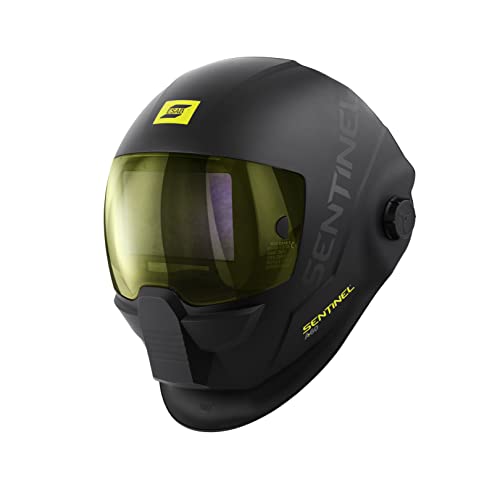
ESAB Sentinel A60 Welding Helmet Black
Experience high performance and comfort with the ESAB Sentinel A60 welding helmet.
Product information
Product Review Score
4.22 out of 5 stars
(137)Product links
Sensors, sensitivity and delay
- Arc sensors. Two sensors are common on budget helmets, four on most mid range ones. More sensors make it less likely that a hand, a part or the torch blocks the arc from the lens, which matters most for TIG and out of position work.
- Sensitivity. How much light it takes to trigger the lens. Low amp TIG needs a higher sensitivity setting.
- Delay. How long the lens stays dark after the arc stops. A longer delay suits high amp work where the metal glows after the weld.
- Grind mode. Locks the lens light so you can grind without lifting the helmet.
Viewing area and true color
The viewing area is the size of the lens window. Larger windows help when you move along a long joint or weld out of position. "True color" lenses are tuned to show less green tint, so the puddle and the metal look closer to their real colors. Optical class ratings, often written as 1/1/1/1, describe clarity, distortion, uniformity and angle dependence; lower numbers are better.

SSimder RLM-1000 True Color Auto Darkening Welding Helmet
Product information
Product Review Score
4.78 out of 5 stars
(104)Product links
Power and weight
Most helmets use a solar cell with a replaceable or rechargeable battery as backup. Check the battery type before you buy so you can find replacements. Weight and the headgear matter more than any single lens figure over a long session, so read the headgear description and the weight together.
Going through the helmets in this store, the optical class was the figure listed least often, and reaction time was missing from more listings than you might expect. Both are usually printed on the lens label, so look for it in the product photos.
A flip front or passive hood still has a place as a spare or for stick welding:

YESWELDER Lightweight Flip Front Welding Helmet
This helmet combines lightweight design with excellent protection for versatile welding tasks.
Product information
Product Review Score
4.83 out of 5 stars
(166)Product links
Compare more in welding helmets.


